Did they seed when there was anything to seed?
UTAH · 203 SEEDED STORM PERIODS · 184 HRRR ANALYSES · WINTER 2024–25Layer 3 of this site's forensic method asks the cheapest and most decisive question about any seeding claim: could seeding even have worked — was there supercooled liquid water in the silver-iodide window, where the operators were set up to reach it? Until now we have run that check on single claimed events. This case runs it on an entire season of an operator's own decisions: all 203 seeded storm periods that Utah's programs reported for 2024–25 RECORD (17,143 generator-hours, from the storm log adopted in Case 002), audited against the public HRRR archive with the same seedability v2 classifier that runs this site's live loop.
The method: for every UTC day of every seeded period — and of all 121 detected precipitation events, seeded and unseeded — we pulled the 00z and 12z HRRR analyses (184 archive hours, none missing), classified the full grid (supercooled liquid water path over 500–900 mb, liquid-weighted temperature in the −8 to −25 °C window, glaciation check), and read the class at all 181 actual generator sites — at each site's own column and 25 km downwind along that period's 700 hPa wind, the middle of the 5–45 km plume band. Each period is scored at its best sampled hour MODELED. Twice-daily sampling can only miss seedable windows, never invent them, so every number below is a floor.
Finding one: the operators pass the audit
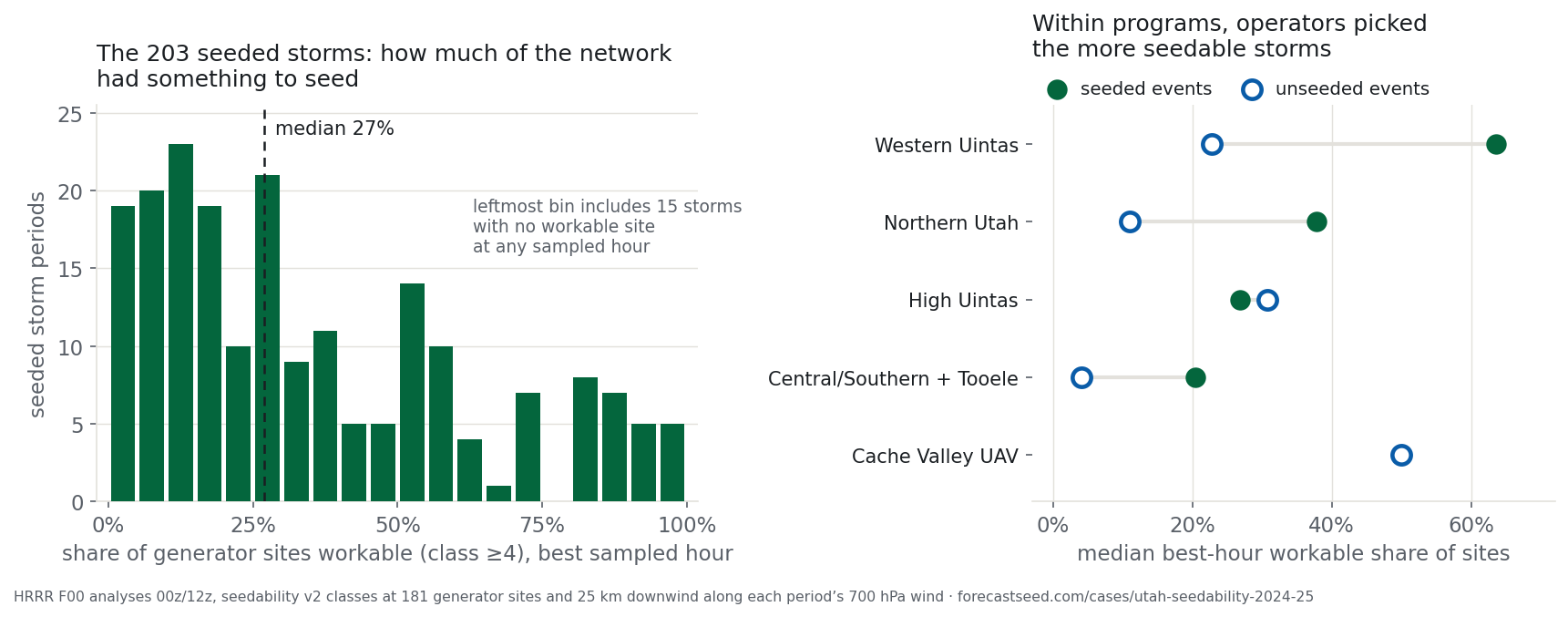
SELECTION SKILL, MEASURED FROM OUTSIDE92.6% of the 203 seeded storm periods — carrying 98.2% of the season's 17,143 generator-hours — had at least one generator site with workable supercooled liquid at the best sampled hour, and 77.3% had at least one site in the fully seedable class MODELED. For scale: over this same season, seedable-class conditions existed at these same sites only 0.8–4.9% of all hours by program (2.6% site-weighted) — the 2024–25 season climatology, computed from all 1,447 archived analyses with the identical classifier, is this audit's own denominator. And the skill shows within programs, where composition can't confound it: in every program with both seeded and unseeded events, the seeded ones were as seedable or more — Western Uintas median workable share 64% seeded vs 23% unseeded, Northern Utah 38% vs 11%, Central/Southern 20% vs 4%.
This is the physical half of Case 002's statistical finding, established with an independent instrument: Utah's duty meteorologists really do light the generators when the wind, temperature and liquid favor the targets. That is good meteorology — and it is precisely the behavior that makes the program's own target/control evaluations uninterpretable, because storms chosen for seedability were going to out-snow the controls anyway. The +335% of Case 002 and the 93% of this case are the same fact seen from two sides.
Finding two: the network is mostly dry even when the storm is right
THE DILUTION THE EFFECT SIZES REQUIREThe other half of the histogram is just as important. The median seeded storm had workable conditions at only 27% of its program's generator sites, even at its best sampled hour. Only 30% of seeded storms — a quarter of the generator-hours — had a majority of the network in the window; the median share in the strictly seedable class was 14%. And 15 storm periods (7.4% of the log, about 2% of the generator-hours) showed no workable site at any sampled hour at all MODELED — some of which will be short seedable windows our twice-daily sampling stepped over, and some of which were, on the model's evidence, silver burned into unseedable air.
This is the arithmetic that reconciles the physics with the statistics. SNOWIE proved a seeding plume in the right cloud makes snow; but a program's effect at the gauges is averaged over a network where, in the typical seeded storm, roughly three quarters of the sites had nothing to work with. A per-plume effect in the single to low double digits, diluted that way, lands exactly where Case 002's most selection-robust designs land: a few percent per seeded storm, indistinguishable from zero at one season. The three numbers — SNOWIE's plume physics, this audit's 27% median coverage, and the wind-rotation estimate of +1.5 to +4% — are mutually consistent, and none of them is consistent with 3–15% of a winter's precipitation.
Finding three: they caught most of what the season offered
OPPORTUNITY CAPTURE · THE CONVERSE AUDITFindings one and two ask whether the seeded storms were seedable. The converse question is how much of the seedable season went unseeded. Extending the same per-hour audit to every 00z and 12z of the season (362 analyses, Nov 1–Apr 30) and splitting each program's workable site-hours by whether they fell inside a reported seeded period: the seven ground programs' seeded periods spanned only 31.8% of the season's hours — but captured 83.3% of the workable site-hours and 83.4% of the strictly seedable ones MODELED. Western Uintas caught 92%, Northern Utah 87%, Central/Southern 84%; the small Book Cliffs program was the laggard at 62%. (The Cache Valley UAV program reports no ground-generator storm periods, so capture is undefined for it; its 17 seedable site-hours are excluded.)
Put the three findings together and the operational picture is coherent and, frankly, competent: Utah's duty meteorologists run their network like a good storm-chasing operation — on duty a third of the time, present for four fifths of the opportunity, almost never burning silver into genuinely dead air. The program's problem is not execution. It is that even executed this well, the physics on offer — a quarter of the network in the window in the typical storm, per-plume yields in the SNOWIE range — cannot add up to the 3–15% the evaluations claim. Capture data: ut2425-capture.json.
What this case calibrates
1. Layer 3 is now a standing instrument, not a per-claim chore. The audit machinery takes any operator's storm log and any date range and returns the atmosphere's side of the story from the public archive. Future seasonal reports — Utah's or anyone's — can be audited the week they publish. 2. Operator skill and operator bias are the same measurement. An evaluation design that ignores how well operators pick storms will read their skill as seeding effect; this case measures the skill directly, from outside the program. 3. Coverage, not chemistry or timing, is the binding constraint. Timing is already excellent — 83% of the seedable site-hours were captured inside seeded periods. If the typical seeded storm still reaches only a quarter of the network, the headroom is in generator placement relative to where the supercooled water actually sits — a testable prediction the audit can track season over season.
Honest limits: HRRR under-produces shallow orographic liquid in some regimes and the 00z/12z sampling misses short windows — both push the audit's numbers down, which is why they are floors and why the 15 zero-workable storms are flagged, not prosecuted. The class is read at point columns, not from full plume transport; "workable" means the marginal class (SLWP ≥ 0.05 mm in the window, liquid-dominant) with the stricter seedable class reported alongside. Report dates are local calendar days audited on UTC boundaries with a trailing analysis.
Method and data: HRRR F00 analyses from the AWS noaa-hrrr-bdp-pds archive (184/184 sampled hours present); classifier and thresholds identical to the live Seedability product (ingest/seedability_ingest.py); audit scripts ingest/seeding_audit.py and ingest/seeding_capture.py; per-period results published at ut2425-seedability-audit.json. Storm log, event catalog, per-period winds and generator coordinates mirrored from Judy 2026 (bryjudy/seeding-verification) — see Case 002 for that study's provenance and this site's verification of it. Baseline seedable-hours climatology: January 2026 pilot.